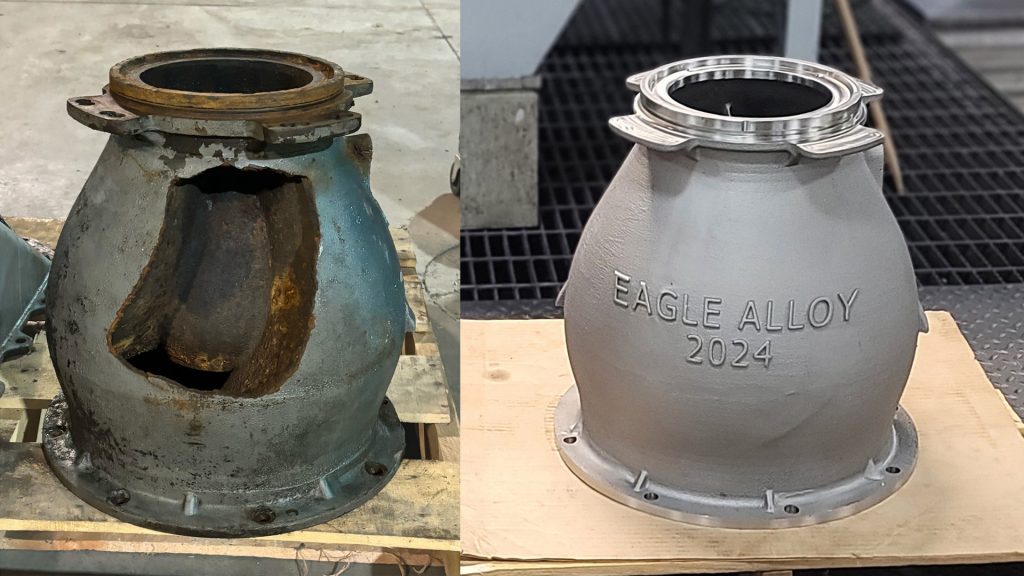
When time and flexibility matter most, rapid prototyping for casting offers a fast-track solution for producing complex metal parts in small quantities. At the Eagle Group, we use this advanced approach to support prototyping and low-volume production, helping customers refine designs and move quickly from concept to casting without the delays and costs of traditional tooling.
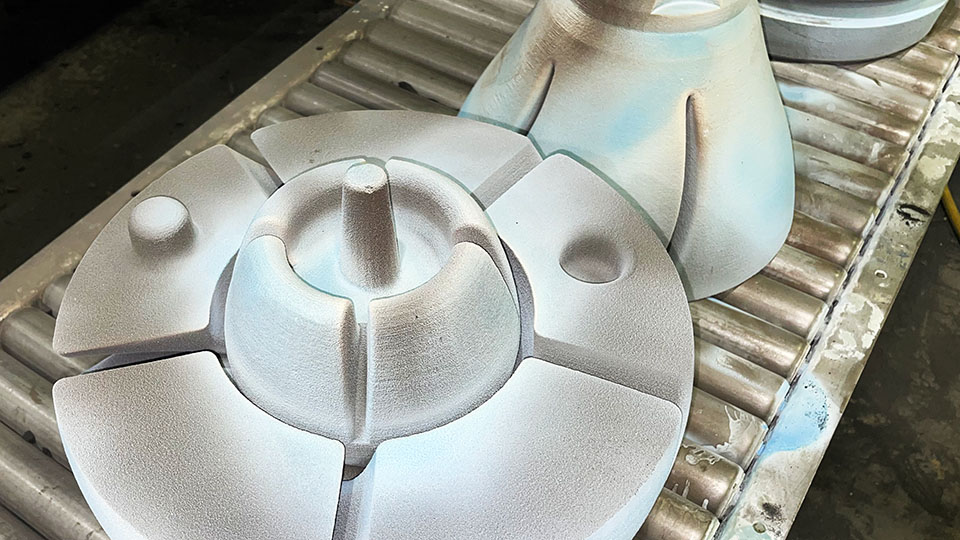
For rapid prototyping, Eagle Alloy often employs 3D-printed molding to save time and up-front tooling costs. We partner with trusted additive manufacturers, such as Humtown Additive, to directly integrate 3D-printed sand molds and cores into our foundry process. This allows us to deliver complete casting solutions using printed tooling—without compromising quality or lead time.
What Is Rapid Prototyping for Metalcasting?
Rapid prototyping for metalcasting combines additive manufacturing with traditional metalcasting processes. Eagle Alloy, the Eagle Group’s shell mold and airset foundry, employs 3D-printed sand molds for rapid prototyping of castings. Using a digital model of your part, specialized printers build sand molds and cores layer by layer. Once printed, the molds are cleaned, cured, and shipped to Eagle Alloy for pouring and finishing.
This tooling-free method is ideal for jobs that require fast iteration or only a limited number of parts. It also enables complex internal geometries that would be difficult or impossible to achieve with traditional core assemblies.
When to Use Rapid Prototyping for Metalcasting
This process works best when:
You need to test a new design or material
You want to avoid permanent tooling investment
You require only a small number of pieces
Your part design includes complex or undercut features
Short lead times are critical to your development cycle
Dimensional Tolerances
Linear: ±0.045″ per inch
Angular: ±1 degree
Casting Characteristics
Surface finish: 200–420 RMS
Minimum wall thickness: 0.250″ (6.35mm)
Typical part weights: 2–400 lbs
Typical production quantity: 1–100 pieces per run
Inside the Rapid Prototyping Process
Our team uses in-house CAD and solidification simulation software to design mold geometry, gating systems, and pour strategies. We then coordinate with our additive manufacturing partners to produce sand molds and cores tailored to each job. Eagle Alloy then integrates these printed components to form complete molds and pours them using standard foundry practices.
Steps include:
CAD model development and gating simulation
Partner-supported 3D printing of sand cores/molds
Assembly of printed molds and cores
Casting using conventional pouring methods
In-house dimensional verification via 3D scanning
Benefits and Considerations of Rapid Prototyping for Casting
Advantages
No permanent tooling required
Faster iterations with easy design changes
Shorter development timelines
Enables complex features and internal channels
Limitations
Not cost-effective for high-volume production
Surface finish depends on print resolution
Part dimensions are limited by the printer size
Print volume and material compatibility may limit the scope
Explore Rapid Prototyping for Your Next Casting Project
The Eagle Group leverages rapid prototyping for casting to help customers reduce tooling costs, speed up development cycles, and confidently validate designs. Let’s talk about whether this approach is right for your next project.