Looking to lower the cost of your casting purchases? The key is to find a foundry that incorporates lean manufacturing principles into the process. These three principles can be applied to manufacturing castings, driving down costs significantly:
- Castability
- Bottleneck Solutions
- Optimizing Cycle Time
Castability
{{cta(‘4e3b99fd-c7ae-4f3f-84c4-f760ff3bd9b1′,’justifyright’)}}Castability is referred to in the foundry as a “molder’s bane.” The molder is looking for a casting design that is forgiving of variations in pouring speed and metal temperature, and is also easy to eject. Does the casting have thin walls, sharp edges, deep pockets or a good metal-feed path? Will it be possible to cast multiple cavities?
By working with the right foundry and engineers, a highly castable design can be developed. By tackling these issues in the design stage, you can reduce costs of scrap and lost time, which can have a significant impact on the overal price of each casting.
Bottleneck Solutions
Bottlenecks occur when one aspect of the metal casting process takes longer, or is less efficient, than other aspects. The result is a buildup of cast parts in an unfinished stage, and a backlog of cast parts stuck behind the buildup.
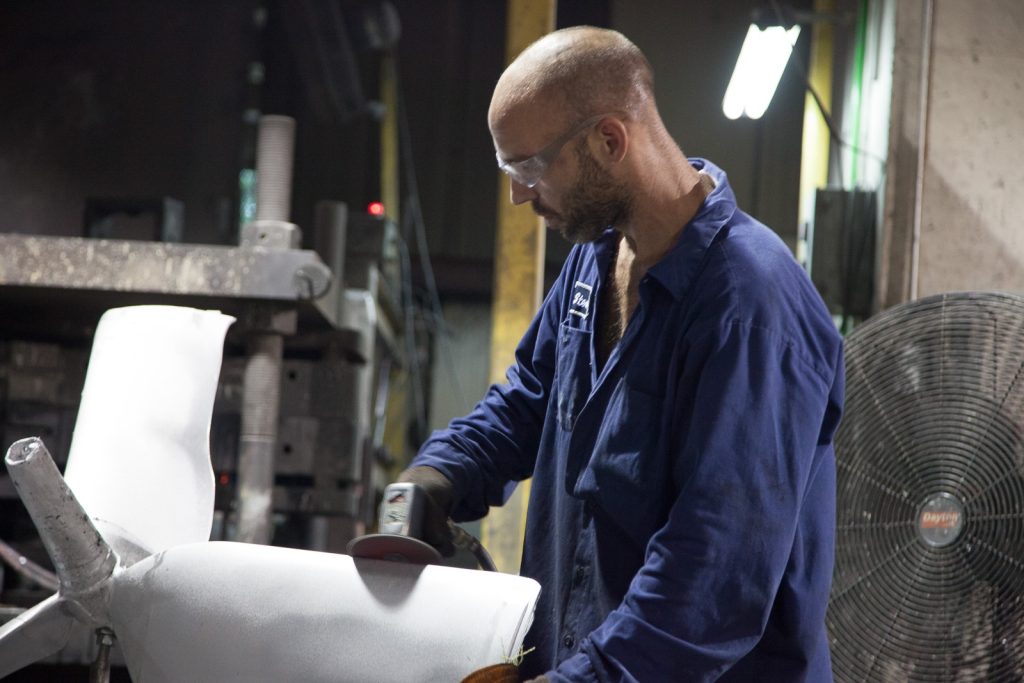
Quite often in foundries, bottlenecks occur in the cleaning room. Lean manufacturing practices focus heavily on cleaning processes to ensure maximum efficiency and throughput.
The size of the casting, as well as the time and type of cleaning, will contribute to the solutions needed to move the castings through the bottleneck.
By reducing or eliminating bottlenecks, manufacturers are able to increase productivity, which in turn will drive down the price of the casting.
Optimizing Cycle Time
Optimizing cycle time isn’t always about reduction of cycle time. Sometimes it can mean the opposite: extending a cycle time to reduce the number of employees needed to manufacture the casting.
For example, increasing the cooling time of the casting could allow a secondary process to be moved into the molding function. Consolidation of functions may necessitate fewer employees, freeing up operators to work on other tasks.
If fewer employees are required to produce a casting, the cost of production goes down and the manufacturer can charge less for the casting.
Ask Your Foundry About Lean Manufacturing
When selecting a foundry to produce your cast parts, be sure to inquire about the application of lean manufacturing principles. If the foundry doesn’t know what you’re talking about, chances are they don’t employ these vital principles, and you could be throwing good money after bad castings.
For more on lean manufacturing, lean tools and manufacturing efficiency, download our Lean Manufacturing infographic below: