
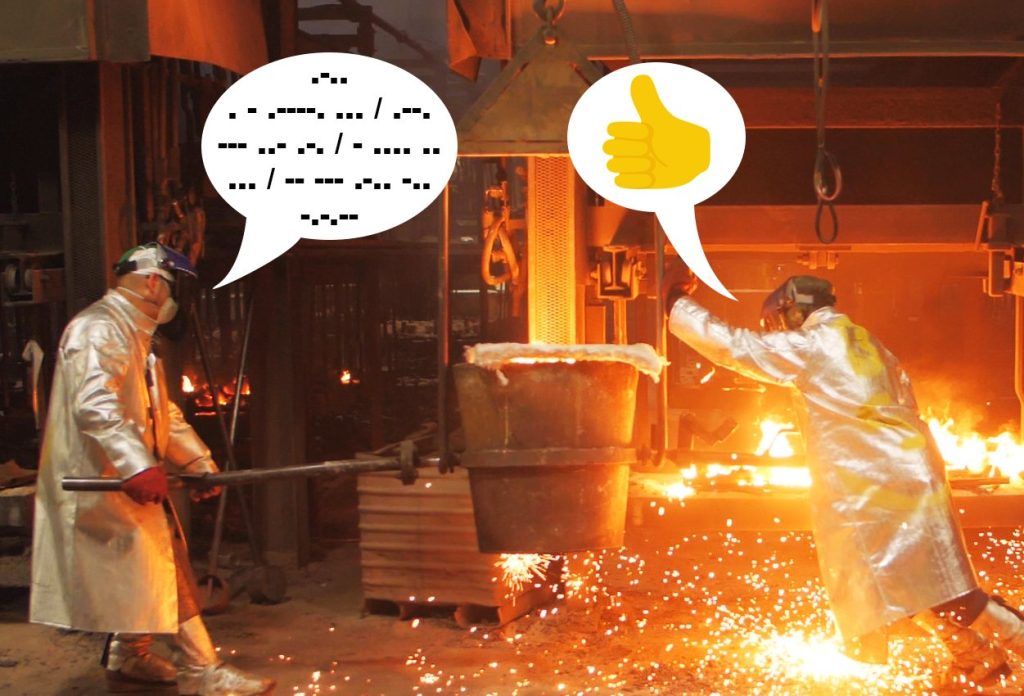
Metal manufacturing professionals are a close-knit community, and just like any specialized group, we’ve developed our own way of speaking. To outsiders, many of whom are our friends, family and customers, metalcasting & machining lingo might seem like another language entirely. Here, we aim to demystify metalcasting & machining jargon so anyone can join the conversation.
Words and phrases specific to metalcasting & machining can be broken into a number of categories: scientific terms, acronyms, shop talk, and alternate uses of common words. In order to achieve fluency, speakers must have an excellent command of all categories.
Category 1: Scientific Terms
These entries in the metalcasting & machining jargon dictionary come straight from physics, engineering and chemistry textbooks. Some have casual, everyday uses as well, but these terms have precise definitions that matter in manufacturing.
- Alloy – Any metal formed by mixing other metals.
- Ferrous – Describes any metal containing iron (as opposed to non-ferrous metals, which do not contain iron).
- Induction Heating – A contactless heating process, during which an object capable of conducting electricity (like metal) is forced to interact with a magnetic field. Our foundries often use this process to melt alloy before pouring.
- Metrology – The science and practice of measurement.
- Permeability – A material property that allows gases to pass through an apparently solid surface; often used to describe mold material.
- Slurry – A flowing mixture containing an insoluble substance (like ceramic) with a liquid (like water or oil). Investment molds are dipped in a slurry to create hard shells.
Category 2: Acronyms
Many of the processes, techniques and procedures used by manufacturers on a daily basis just take too long to say, so we use acronyms to get these ideas across more efficiently.
- APQP – Advanced Product Quality Planning: a process developed in the late 1980s to facilitate product development and production within the automotive industry. Widely used today across the manufacturing sector.
- CNC – Computer Numerical Control: A method of automating machining processes through computer software and hardware attached to machine tools.
- DFM – Design for Manufacturability: An engineering practice resulting in products that are easier to manufacture; focuses on fixing manufacturing problems in the design phase, resulting in parts that are more efficient to assemble.
- ECN – Engineering Change Notice: A document that notes and/or authorizes design changes
- GD&T – Geometric Dimensioning and Tensioning: A system of symbols and values incorporated into engineering drawings to communicate engineering tolerances.
- PFMEA – Process Failure Mode Effects Analysis: An analytical system used by multi-role teams to identify and rank potential failures of a given process.
- PPAP – Production Part Approval Process: An aspect of Advanced Product Quality Planning (APQP) that consists of preparation of a series of documents that show the customer that the supplier is able to meet their production requirements.
- Ra – Roughness Average: A measurement of surface finish taking the average height of the microscopic peaks and valleys making up a given surface.
Category 3: Shop Talk
This category is a mixture of scientific terms and a kind of manufacturing slang used to describe situations that only happen in casting & machining processes.
- As-Cast Condition – Condition of a casting that has not been machined or otherwise processed.
- Location Surface – An area of a casting used as a reference point in making measurements for finishing.
- Machine Stock – The amount of extra metal stock remaining on the surface of a casting for machining.
- Near Net Shape – A classification of products, often castings, that require little or no finishing before they are put into use.
- Patternmaker’s Shrinkage – The shrinkage allowance, different for every casting material, made on all patterns to counteract shrinking of the metal as it cools in the mold.
- Pilot Casting – A casting made to check quality and dimensional accuracy before mass production.
- Recovery Rate – A percentage based on the ratio of saleable parts to total parts manufactured.
- Roughing – Rapid removal of material from stock to produce a workpiece approximating finished dimensions.
- Tooling – An object produced as a prerequisite to a mold or core, representing the approximate shape of the part to be cast and used to create the mold or core.
Category 4: Alternate Uses of Common Words
When metalcasters and machinists talk shop, you’ll hear quite a few familiar words used in a totally different context. From “Allowance” to “Ways,” here’s a sample of new definitions you’ll need to learn:
- Allowance – The amount that mating parts are allowed to differ in their dimensions in order to provide an adequate fit.
- Apron – In machining parlance, part of the lathe carriage that both protects the mechanism and contains controls for moving the carriage.
- Bed – A principal component of a machine tool, consisting of a ways or other surface for supporting and aligning other machine parts.
- Boring – A machining process used to enlarge and finish pre-existing holes.
- Boss – An elevated or enlarged area of a casting, allowing a hole to be machined.
- Chill – A metal insert intended to induce localized temperature drops, equalizing the rate of solidification throughout the casting.
- Cope – The top half of a two-part casting mold.
- Cure – To allow a mold to harden.
- Drag – The bottom half of a two-part casting mold.
- Heat – Metal put into a single furnace, or a single furnace charge.
- Pig – A block of a metal, often iron or aluminum, intended for melting to form an alloy.
- Stock – Unfinished materials, such as bar stock, used to make parts in a machine tool.
- Tap – A tool used to cut inward threads into a circular hole.
- Ways – A linear or v-shaped surface that supports and guides moving parts.
To continue your study of metalcasting & machining jargon, consult our online glossary with definitions of over 200 words, phrases and acronyms used by metal manufacturing professionals.